

Overview
Deferral is the result of my Master's thesis at the University of Zurich (2022/2023). It is a set of tested and documented Solidity smart contracts that investigate whether a high-volume, fully decentralized referral system is economically and technically feasible on EVM-compatible blockchains.
Contract families
The solution implements and compares five referral mechanisms, each as upgradable smart contracts:
- Multilevel token rewards — referral rewards paid out in ERC-20 tokens across multiple levels
- Payment multilevel rewards — multilevel rewards settled from payment flows
- Payment quantity — rewards based on the number of completed referrals
- Payment transmitter — a thin forwarding mechanism for referral payments
- Payment value — rewards proportional to transacted value
Evaluation
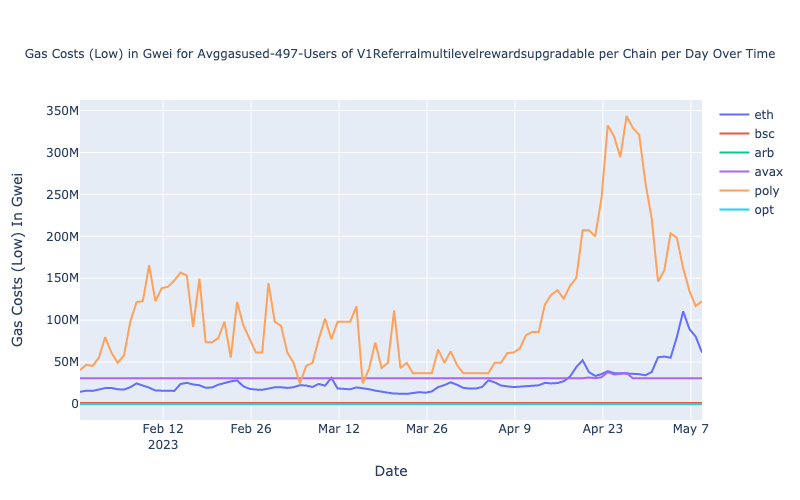
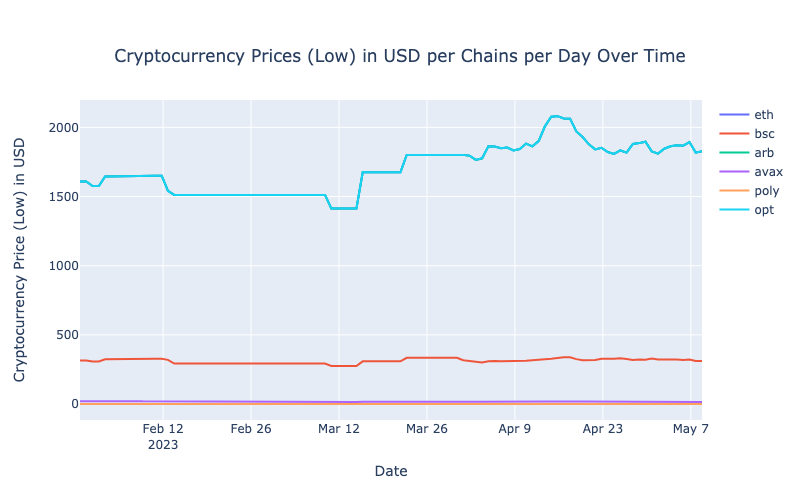
Each contract was deployed and exercised across a range of user volumes, then measured for gas usage, transaction duration, and real-world fiat cost. The evaluation spans six networks — Ethereum, Polygon, BSC, Arbitrum, Optimism, and Avalanche — to compare how cost and throughput scale per chain over time. The charts below show low-estimate gas costs and the underlying token prices across chains during the evaluation period.
The evaluation treats feasibility as a measurable trade-off rather than a single yes-or-no result: the practical cost of a referral design depends on the selected mechanism, expected volume, and deployment network.
Toolchain
Built with Hardhat as the development environment, with TypeChain generating type-safe contract bindings for the TypeScript test and deployment scripts. Code quality is enforced with Solhint, Solcover (coverage), ESLint, and Prettier, and UML class diagrams are generated with sol2uml. CI runs linting, compilation, and the full test suite with coverage on every push.
The result data is analyzed and plotted in a companion repository, visualizations-deferral, using Python and Plotly.
The research was published as a short paper at BRAINS 2023.